
Un message qui fait le buzz, publié par Recent_Response_168.
Le dernier contenu de Recent_Response_168 a été mis en ligne sur Reddit récemment
Cette publication est présentée avec cette description:
Hello, dear people of this Subreddit!
Since this is my first post here, allow me to make a quick introduction first to provide some context. The actual post starts right afterwards, feel free to skip it.
I am a lawyer, studied at Oxford and Hamburg, both a British and Swiss national, born in Northumberland, UK, went to boarding school in Switzerland, and now I live and work in Germany. At boarding school I met my partner of now over 15 years who currently works as a psychiatrist. Both of us come from strict, conservative, religious households, and you can figure out the rest for yourself…
Anyway, still in school, we quickly adopted a relationship dynamic that included me spanking her for certain behaviour, and just generally being in charge. Over time this developed into a full domestic discipline relationship, applying to every aspect of our life. Besides that I have a handful of girls, mostly German university students, who come to me for coaching or tutoring, and with whom I use strict measures like spanking or corner time or limiting their screen time outside of our sessions. On top of that we have one university student living with us at home who is also subject to certain rules and punishments.
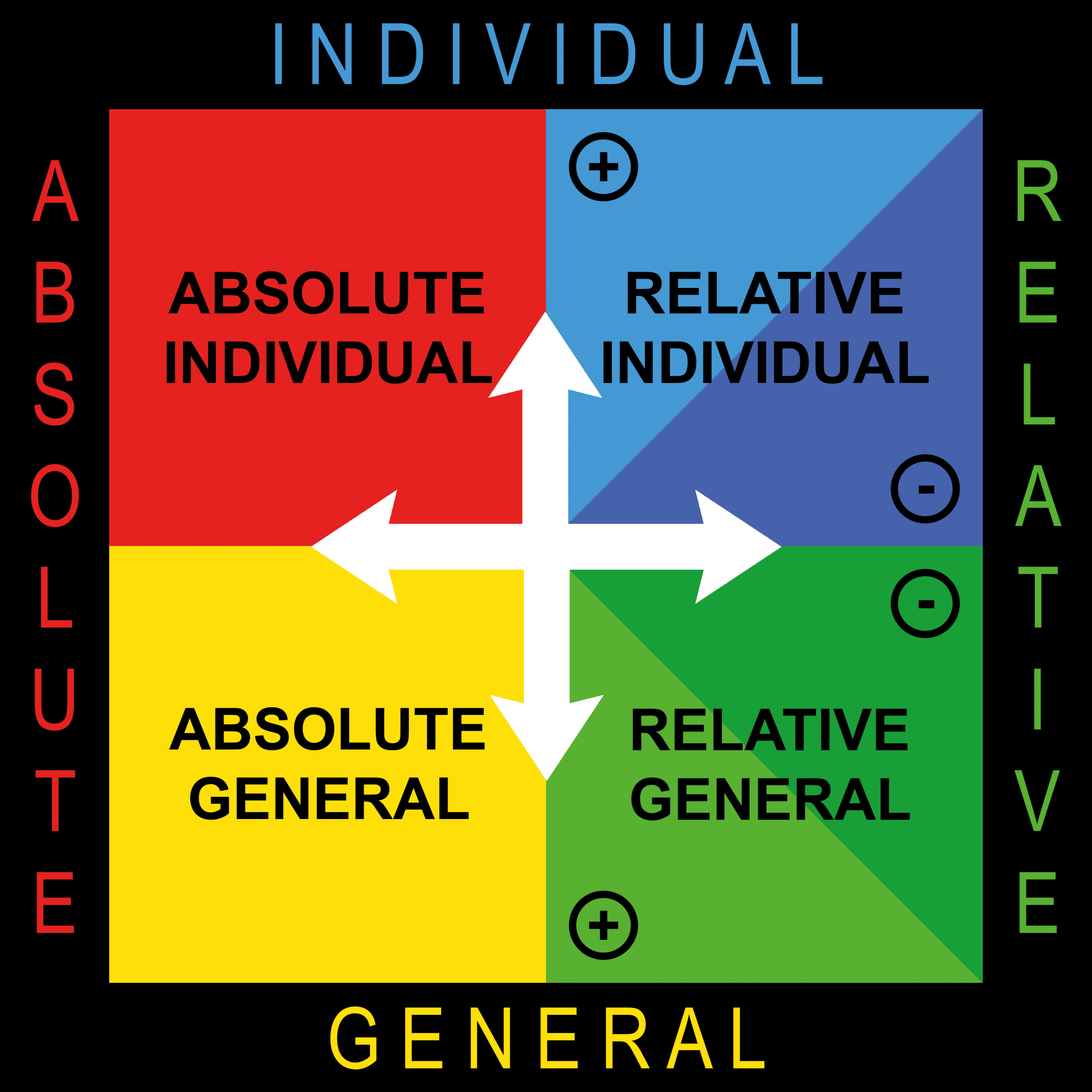
What came up in criminal law courses in both England and Germany were the philosophies in the legal system about how and why we as a society impose punishments on people, paired up with psychological input and studies from actual criminal science. I make use of all this knowledge and refined my approach to discipline over all this years, and I’d like to share with you the colourful figure above and some explanations regarding it.
I shouldn’t have to explain the figure, but just to rule out misunderstandings, I will do it anyway. There are two axes, the purpose axis absolute – relative and the target axis general – individual. The overlap of these axes provides us with four sectors, which are the aspects or criteria each punishment should meet. But not everyone gives equal weight to all of these aspects. The job of the dominant partner is to create punishments that are tailored to meet the individual priority of the submissive partner in regards to these six aspects of punishment.
Because the relative aspects are… well, relative, they aim to prevent one thing and encourage another; that’s why they are split into two parts.
Lastly, a word regarding the wording: I will mostly talk about the roles as “the offender” and “the enforcer” and “the society”. This post can be applied to every relationship. Of course to your partner, this is my main goal today, but also to your children, boss or colleagues, friends and so on. I will focus on domestic discipline relationships between adults who actively agreed to do it that way, but everything I present here is equally applicable to all relationships, and it is easier to find relatable examples if I can pick from a broader spectrum. Society can also mean everything from your relationship with your partner, to your household, friends, office, or country. I will also use the pronouns he / him for all roles when giving generic examples besides being in a heterosexual relationship myself.
Okay, so… why do we punish? Here are the aspects to keep in mind!
(I) Absolute
The absolute aspects serve what I – in lack of a better name – call “discipline fetish” and it’s definitely something I myself am guilty of.
And this is what the absolute aspects attend to. The unexplainable longing for discipline. The absolute aspects are axiomatic, if you will. Their rationale is absolute, meaning there is no real logic or purpose behind them. It is dogmatic. It is because it is. Did your parents ever say “Because I said so” ? Well, there’s your absolute!
(1) Absolute Individual
The rationale of the absolute-individual aspect is to offer the offender to “come back” into society.
The offender broke a rule. He can not be trusted to follow the rules, so we have to exclude him in order to uphold the rules. If he doesn’t want to follow the rules, then he can’t be part of our society. We must know that everybody follows the rules and if not, is excluded. This is how society provides not just a feeling of security but actual security.
By accepting the punishment, the offender can now demonstrate that he is willing to accept the rules again. And since breaking a rule triggers whatever punishment, that is the first step; accepting the consequences of your behaviour, i. e. the defined punishment under the rule set.
For my partner, our domestic discipline dynamic offers her the stereotypical gender roles that she wants for the sake of control, predictability, security, and so on. She as the offender has to submit to me as the enforcer, thus establishing, upholding, and respecting the power dynamic.
And pretty much the same is true for all girls with whom I work. They come to me to have someone who holds them accountable. Not for the lack of success, but for the lack of work. All that matters is that they e. g. did not study. It doesn’t matter that they passed the exam anyway. They didn’t study besides their promise to study, and they will be punished for that. And they want to receive this punishment in order to demonstrate that on principle they still accept our agreement and still want to work on their issues. But before we can continue the session, they have to be punished first to prove that they are willing to uphold our agreement.
The underlying philosophy is called “atonement theory” because it focuses on demonstrating humility. But please note that this is not about forgiveness or atonement or whatever. This aspect is solely about proving to society that you are willing to suffer the consequences of your behaviour in accordance with the rules of the society. It is all about submitting to the rules, subjecting yourself to the rules, and nothing else.
And it may sound trivial, but this requires rules. Duh! you may say, but bear with me here.
The rules to abide by must be as clear as possible to (1) rule out misunderstandings and honest mistakes, and (2) prevent despotism. You don’t have to “calculate” a punishment, e. g. every hour past the cufew equals cancelling one other event, but being severely spanked for an offence and then next time only receiving a short corner time for the same offence is an imbalance that causes problems. The offender must be able to predict the coming punishment, at least to some degree.
You may have all that figured out within your domestic discipline dynamic by now, but you can check on that every now and then nonetheless.
(2) Absolute General
The rationale of the absolute-general aspect is simply action and reaction. No bad deed shall ever go unpunished!
This idea is as old as formal laws themselves. The famous German philosopher Immanuel Kant coined the Latin term “Fiat iustitia pereat mundus” meaning that justice shall be served, no matter what, although that phrase itself is much older. Kant gave the example of a small community living on an enclosed island. If that community decided that all of them would abandon the island tomorrow, and spread out in all parts of the world, then they still would have to kill all those awaiting execution for their crimes. So even if their “world” literally ended tomorrow, they should kill all those on death row first.
The underlying philosophy is called “retribution theory” because it is focused on retaliation. But not in the sense of revenge or like “let’s get him”, rather in the sense of “an eye for an eye”. Think about it this way: When you scratch someone’s car in the parking lot, you can apologise. And the car’s owner may even forgive you. He won’t press charges and he won’t hold a grudge against you. But he still wants you to pay for repairing the scratches.
This aspect is also what makes a discipline dynamic so appealing to me. I myself am strongly autistic, scoring very high in most of the spectrum’s categories, and for me my discipline dynamics are all about law and order. We agree on rules for e. g. our household and I expect my girls at home to abide by those rules. And if not, there have to be consequences. If a girl I tutor didn’t prepare for our session, she gets spanked. It doesn’t matter that her behaviour didn’t cause any serious problems. All that matters is: She did not do what we agreed on, so she gets punished.
Contrary to the absolute-individual aspect, this is not about proving your willingness to submit, this is really just the enforcer’s reaction to the offender’s action. This is not about you obeying the rules, this is society forcing you to obey. Two sides of the same coin, basically.
For the submissive partner of whatever kind, this is often an important aspect. The knowledge that he will be punished accordingly – every single time, which gives a sense of coherence, belonging, and predictability, and thus security. In a domestic discipline dynamic, the TiH often craves exactly this; the knowledge that there will be punishment, no matter what.
The most important part for the enforcer is to be coherent in administering punishment. If the offender broke a rule, there MUST be punishment. It can vary in intensity to account for varying severity, but something MUST happen every time for the whole thing to work.
For the dominant partner enforcing the rules, this might be what you have to worry about the most. Being coherent and relentless about dealing out punishments can be very demanding and even exhausting at times, but the whole thing will only work if you keep up your part as well.
(II) Relative
Contrary to the absolute aspects, the relative aspects have a clear goal or purpose to them. Punishment is not just administered for the sake of punishing, there is more to it. The punishment shall have certain effects – on the individual and the whole society.
(1) Relative Individual
Individual in this case means the offender. The punishment is meant to get the offender to do something (+), and also is meant to prevent (-) the offender from doing something.
(a) Provides
The punishment offers the offender the possibility to atone for his offence. But this time, it is really about atonement, about feeling sorry. The offender suffers through the punishment in order to pay for his offence.
In discipline dynamics, this is usually important for the submissive partner. He gets to free his conscience from the guilt he may have from committing his offence. Maybe he physically hurt or endangered somebody, maybe he caused a lot of trouble by missing a deadline, and so on. Maybe he feels bad because he let himself down by not making use of his full potential and is now angry at himself. And by suffering the consequences in the form of the punishment, the offender can forgive himself afterwards more easily.
For me, this was a huge factor growing up. My whole social circle, back then and now still, is very conservative. Until the age of around 17, both my sister and I got often spanked, had to do corner time, writing lines or essays, and basically the whole package. There were some rules that were… debateable, but overall we had no crazy, useless rules. And while the punishments might be called severe and the rules were consistently enforced, it was clear that after the punishment was over, all was well again, everything was forgiven. And our parents really stayed true to that. Which is of course a requirement for that to work. You can’t just say it, you have to practice it as well.
It might also be the most important factor for the girls I coach and tutor. Most of them would do perfectly fine without me. They do better because I coach and tutor them, not because they get spanked or have to kneel in the corner. But those who come to me often can’t handle the thought of failure. It’s not about receiving a bad mark or a good mark, it’s that they could have done better with just a bit of work. Then they feel extremely guilty, and that eats them up. Sometimes to the point where they are totally paralysed and don’t do anything at all. Getting spanked for this or having to write e. g. an apology letter about it helps them to come clean with themselves again, which then enables them to go back to work with a clear mind.
(b) Prevents
The punishment is also supposed to keep the offender from repeating the punished behaviour.
Usually, this is the only aspect of a punishment that is ever talked about, mostly in the context of raising children like “Punishing kids doesn’t work”.
Now, the truth about this aspect, whether in regards to children or in general is this: Yes, it does work. Punishing unwanted behaviour decreases the appearance of that behaviour.
However, there is a BIG caveat to this: It only works when applied consistently, as already mentioned previously. If you don’t punish an unwanted behaviour every single time, it won’t work. And even when applied perfectly, punishment is not the most effective method.
Think about it. We have speed cameras everywhere. Depending on your country, going over the speed limit can be crazy expensive. But people still go over the speed limit. If they only ever caught one driver per year because everybody kept the speed limit, there would be no speed cameras anymore. Or think about yourself as a teenager. Did you ever sneak out at night although you weren’t allowed to? I did so several times because my boarding school was very strict about going out during the week. Risking detention or getting grounded never stopped me from sneaking out with friends when there was an event we really, really wanted to go to.
So, plain and simple: Punishment is not really the tool of choice to improve behaviour. No matter the context, if you use punishment to improve behaviour, maybe consider changing methods. On the other hand, this doesn’t mean that punishment is useless. It’s just that most people use it in the wrong way, i. e. to achieve something that punishment is not really good at achieving.
And I know this is not our topic today, but a quick, important side note: Especially with smaller children it simply does not work because they lack understanding. It doesn’t matter whether you spank, or yell, or give time outs, or take away toys, or whatever. It’s not about the measure, it’s about the method. E. g. Children before the age of 3 can’t really understand that other beings have feelings too. So if a child pinches a younger sibling, they are literally unable to realise that this hurts the other person. Or if you make a 4-year-old sit in the corner because he threw a tantrum, he may stop throwing tantrums eventually. But not because he learned to deal with his feelings. He stops because he learned to suppress his feelings. But it seems like a success from the outside, and that is the problem. And younger children may not even pick up on the connection between behaviour and punishment. They don’t learn that they get punished for this or that behaviour. All they learn from it is that they get treated badly. Just because a 3-year-old can talk doesn’t mean he understands the full meaning of something, even less so social concepts like etiquette or swear words.
The take-away from this should be:
There are several aspects to a punishment. Improving behaviour in a way the enforcer wants it to be is only one aspect. Punishment is not the best tool to improve behaviour, but it certainly has an effect on improving behaviour, although you have to employ other methods hand in hand with punishment to tackle unwanted behaviour effectively. Punishment alone won’t do much. So not only think about punishments in your discipline dynamic, but also rewards. And make them co-dependent. Try to have a reward for everything that is punishable. If you have a rule that says the TiH will be punished for something, also think about how the TiH can be rewarded if he persistently changes his behaviour and consistently avoids a punishable behaviour. It is not enough to not punish, there has to be an additional reward of some sort. Not being punished in itself is not a reward.
(2) Relative General
General in this case means the society. The punishment is meant to provide (+) the assurance to the society that “justice was served” and also to prevent (-) others committing the same offence by reminding them of the possible consequences.
This aspect can mostly be ignored in dynamics between only two people, so it may not really be applicable to your domestic discipline relationship, but it is part of the scheme and I will talk about it nonetheless. Better know and not need than need and not know, right?
And guess what, the HoH is also part of “the society” in this case because he is not the offender. Between the HoH and the TiH, the HoH is “everybody else” in that dynamic. So this aspect is mostly about what the HoH will get out of it.
(a) Provides
Think about yourself. Was there at least one occasion where a sibling or a friend got in trouble and you found it just so satisfying to know that they got punished? I know I did.
“Cheaters never prosper” is simply not true when it comes to justice. Often enough people get away with bad stuff. Lying, fraud, tax evasion, straight out robbery, etc. But all the more it can be extremely satisfying when someone gets actually caught and punished for bad stuff.
And let’s be honest here, even with your significant other in a domestic discipline relationship the HoH will not get the TiH on everything. The TiH might confess some of that, but either way you will miss out on some things. And that’s just the way it is. No system is perfect, so we just have to live with that.
But what the HoH can get out of a punishment is (1) the sense of purpose by fulfilling this part of his role as HoH, (2) the sense of achievement because he did his job and “caught” the TiH on something, and (3) the sense of satisfaction because justice was ultimately served.
This might sound trivial, but don’t underestimate the effect this can have. Administering the punishment helps the enforcer to let it go the same way the suffering of the punishment helps the offender to put it behind him. Again, it’s basically two sides of the same coin.
I have the personal rule to always punish with a cool, leveled head. And most of the time I am not even really enraged by the behaviour I punish, whether that is from my partner, our live-in student, or the girls I tutor. But even then I find it very calming to administer a punishment and it definitely makes it easier for me to get over it because I can actively do something. Especially when I spank as a punishment I can literally let my frustration out on them. Although watching someone doing corner time or writing lines is almost equally satisfying. I once had a girl I tutor compare it to “angry sex” which is something I haven’t experience yet, but I think the comparison sounds reasonable.
At least in our household we also have the additional party of our live-in student who is subject to a slightly different set of rules and punishments than my partner, but nonetheless she and my partner know that whatever one of them does to the other will not go without consequences, and that already does a lot to keep the piece.
(b) Prevents
The prevention side of the general-relative aspect means that all others of the society are reminded about the consequences for breaking the rules. By knowing that the offender is getting punished or even witnessing the punishment, everyone else will be reminded that the same will happen to them if they commit the same offence.
Little anecdote: I have a co-worker who told me that at his school, decades ago, after caning pupils was already banned, the headmaster himself spread the rumor that pupils would still get a severe beating if they were sent to the headmaster. In reality, the headmaster had never beaten any pupil, not even when he was still allowed to do so, and the rumor alone was enough to keep some pupils in check. Those who actually got sent to the headmaster’s office would only receive a harsh scolding, but would also not tell the truth, and nobody believed those who told what actually happened to them.
For this, the same is true as for the change of behaviour with the offender. All other members of the society are more likely to abstain from certain behaviour if they know that and how this behaviour will be punished, but this is only a minor effect. It will do some good work, but don’t count on it too much.
However, this might be the least applicable aspect to a domestic discipline relationship anyway, so just think of it as a little extra on top.
— Thank you for reading —
En examinant ce post, nous avons vu qu’il y avait 10 interactions. Les utilisateurs de Reddit peuvent interagir dans des discussions et exprimer leur avis sur les publications dans des communautés couvrant de nombreux sujets.
Cultiver un équilibre de domination respectueux et durable
L’importance capitale du consentement éclairé et de la confiance
Pour qu’une sanction soit efficace et respectueuse en sadomaso, il est nécessaire de bien connaître son ou sa soumis·e. Cela permet d’agir dans un espace sécurisé, avec consentement et pertinence érotique, en tenant compte de ce qui excite et de ce qui peut troubler émotionnellement. Au sein d’une liaison bdsm, surtout quand la soumission masculine est au centre, le consentement est primordial. Il repose sur une confiance mutuelle forte, maintenue par une communication claire et respectueuse des limites et attentes. Il est vital de poser des limites claires : ce qui est acceptable, ce qui touche la frontière du supportable, et ce qui ne l’est pas. Ces repères aident à calibrer la punition selon les accords et à maintenir la confiance. Il faut aussi définir les comportements qui méritent une sanction, afin que la punition garde son poids, reste exceptionnelle et équitable, évitant l’arbitraire ou la routine. Cette rigueur d’écoute, de préparation et d’intention donne à la punition sa force dans la dynamique dominant·e/soumis·e, quel que soit le genre ou la configuration relationnelle.
Fonctionnement des safewords et rôle des précautions sécuritaires
Échanger est indispensable : discuter avant la séance pour poser les limites, parler des envies et des espaces à découvrir, puis prendre le temps après pour faire le point sur les ressentis, les ajustements et les vécus de chacun·e. Ces attentions ne restreignent pas le jeu, elles en sont la clé : en assurant la protection physique et émotionnelle, elles ouvrent la voie à une circulation harmonieuse du pouvoir dans un cadre de confiance absolue. Le safeword représente le dernier rempart. Il autorise la personne soumise à mettre fin à la session si elle ressent que ses frontières sont outrepassées. Sans cette sécurité, la sanction SM doit devenir abusive. Assurer la sécurité lors de pratiques SM avec punitions ou jeux de domination implique de suivre des règles fondamentales. Choisir un safeword est crucial : ce mot, simple à dire mais rare dans le cadre du jeu, tel que « rouge », agit comme un signal d’alerte immédiat. Il permet au soumis de reprendre le contrôle si ses limites sont atteintes, garantissant un consentement continu. Il est également recommandé de définir un protocole clair permettant de stopper rapidement toute activité en urgence, par un mot, un geste ou un signe convenu, surtout lorsque parler est difficile.
Décrypter la logique punitive dans le cadre SM
Symbolique de punir
Dans une relation BDSM, la punition s’inscrit dans une logique consensuelle et ritualisée de domination féminine et de soumission masculine. Dans le SM, la punition prend diverses formes : elle peut être corporelle, mentale ou symbolique. L’essentiel n’est pas la douleur, mais l’affirmation d’un cadre, le respect d’un ordre consenti, et la stimulation d’une excitation partagée.
Explorer les types de punitions et leurs objectifs
Dans toutes les dynamiques BDSM, certaines punitions – physiques, psychologiques ou sexuelles – jouent un rôle crucial. Elles modèlent la relation, encadrent les comportements et intensifient les liens de domination et de plaisir.
Garantir une récupération émotionnelle et physique optimale
Veiller à l’apaisement émotionnel après la séance
Prendre le temps d’échanger après la rencontre sur les émotions, ce qui a été apprécié ou non, permet d’ajuster les pratiques futures et de renforcer la complicité. L’aftercare est un espace de soin mutuel, de validation et d’ancrage, qui élève l’expérience sadomaso au-delà d’un simple jeu pour en faire un partage humain profond. L’aftercare, étape essentielle du bdsm après une sanction ou une scène marquante, assure réconfort et réparation. Il renforce la complicité entre partenaires. Les rituels varient : un câlin sous une couverture offre douceur et sécurité, un mot tendre rassure et valide l’expérience, tandis qu’un bain chaud ou un massage favorisent la détente et prolongent l’intimité partagée. Après une sanction BDSM, surtout quand elle est forte, l’aftercare s’impose comme un moment fondamental. La personne soumise traverse souvent des émotions intenses — honte, euphorie, tristesse, soulagement — qui doivent être accueillies sans jugement.
la fonction première de la discipline
Dans une relation bdsm, la sanction pratiquée avec respect, empathie et créativité devient un vecteur fort de connexion émotionnelle, de discipline et de désir partagé. Elle permet, dans les couples où la femme domine et l’homme se soumet, d’ancrer une dynamique érotique importante et adaptée.
Placer la punition au cœur des jeux SM
Trouver l’harmonie entre douleur et plaisir dans la pratique
Dans la pratique bdsm, la douleur utilisée lors d’une punition est un outil pour approfondir la dimension psychologique et émotionnelle du lien dominant-soumis. Employée avec sagesse, elle provoque un lâcher-prise conscient de la personne soumise, qui se remet entièrement à la volonté dominante. Cet abandon volontaire constitue une force qui solidifie la relation. La douleur peut aussi engendrer une intensité émotionnelle profonde, souvent cathartique, en permettant de libérer des émotions enfouies et en modifiant l’état de conscience. La douleur dépasse la simple sensation physique pour se transformer en une expérience émotionnelle et sensorielle complexe. Ce partage crée un lien renforcé entre dominant et soumis, basé sur la confiance, le respect des limites et la volonté de s’élever ensemble dans un cadre sûr. Ce qui importe véritablement, ce n’est pas la douleur elle-même, mais ce qu’elle fait naître et bâtit dans la liaison sadomaso. Il est essentiel de rester à l’écoute des réactions physiques et émotionnelles du soumis, car un excès tue le plaisir, tandis qu’une insuffisance affaiblit la discipline. La plateforme où se fédèrent les échanges et publications sur la punition est punish.life.
Les mises en situation et accessoires pour la punition
Pour varier les plaisirs, on peut ajouter des pinces, des bougies ou des cordes, offrant une forme alternative de contrôle et de stimulation. Employés avec soin, ces outils participent à la construction d’un rituel partagé, à la fois sensuel et puissant, où le désir réside autant dans l’atmosphère que dans la sanction elle-même. La punition dans le SM doit se dérouler dans le cadre d’un jeu de rôle ou d’une mise en scène, ajoutant une dimension théâtrale et psychologique à la dynamique de domination et soumission. Ces scénarios permettent d’explorer symboliquement le pouvoir tout en respectant un cadre consensuel et codifié. Par exemple, la dominante peut endosser le rôle d’une cheffe stricte qui punit son employé pour une faute imaginaire, renforçant son autorité par la fiction. Une maîtresse doit également corriger son esclave masculin pour une désobéissance, accentuant la tension entre contrôle et soumission. Certains pratiquent un « tribunal SM » où le soumis est jugé selon des règles établies et puni selon un verdict scénarisé. Ces jeux offrent une expérience riche tant sur le plan érotique qu’émotionnel. Les instruments utilisés varient selon l’intensité des sensations recherchées : la fessée à main nue reste un classique, intime et directe, tandis que la canne, le martinet ou la paddle provoquent une douleur plus ciblée et intense. Retrouvez les publications les plus suivies sur la punition BDSM grâce aux liens proposés par le site www.fetishtop.org.
Ce post comporte des hashtags et des liens:
#punish
Vivez le Ballbusting Sans Bouger de Chez Vous
Le ballbusting ne se limite plus aux rencontres en présentiel. Grâce à la plateforme punish.life, vous pouvez entrer en contact avec des punishers prêts à vous faire vivre des sessions intenses et personnalisées à distance. Une solution idéale pour explorer votre soumission de manière encadrée, où que vous soyez.
Laisser un commentaire
Vous devez vous connecter pour publier un commentaire.